The Plan – 29th December 2017
A new year without a story to tell is as good as a dish without salt: bland, dull, uninteresting. The excitement of welcoming a new year with the same zeal just dies down.
Our new year’s eve plan was heading in the same direction.
With multiple destinations on our list being struck off due to several reasons (read: unfavorable weather conditions, exorbitant hotel rates etc.) we were squandering for a place to escape the cold and f(sm)og engulfing Delhi.
My sister talked highly about an offbeat and unheard tourist spot frequented by foreigners rather than locals. She suggested we couple it with a nearby world heritage site and make it a memorable trip. The suggestion was met with enthusiasm from all corners barring one who thought “temple hopping” on new year’s was quaint to say the least. But I somehow knew that the trip would be memorable.

With very less time to plan, I got on with chalking out a rough itinerary for our two days on the road which included night stay alongwith ticking off all the temples/forts which the place(s) had to offer.
Surprisingly, we faced no hiccups in finalizing and booking hotels for our stay.
The Journey – 30th December 2017
We started from Delhi at around 0600hrs and were expecting to find some fog on the way.

The fog tried to play havoc with the schedule but was not enough to drown our spirits, until our stash of munchies and snacks lasted, that is.
We decided to make a stop before the Gwalior-Jhansi stretch and tame the beast rumbling in our stomachs. It was a decent dhaba with sarson (mustard)fields at the back stretching for miles. While the food was being prepared we had a small photo session with me trying desperately to shake off the tag of ‘least photogenic person in the group’ and failing miserably at it.

The aloo-pyaaz parathas with dal makhani was filling which was topped with dollops of Amul butter which were gladly belted. Soon, we were on our way.
The incomplete Gwalior-Jhansi stretch was disappointing considering that it connects two major cities. It was in the same dire condition as a year earlier (mid 2016). We covered the distance of 95kms in 02 hours and noticed a lot of roadside vendors selling jaggery made from local sugarcane (I assume). We took a left onto the Jhansi-Kanpur highway (NH-27), just outside Jhansi, which was a treat to sore eyes. The highway was freshly constructed but our excitement was short-lived as we had to take a connecting road towards Tikamgarh.
Once on that road, we missed a right turn beside a huge fort-in-ruins and realized a couple of kilometers later that we were on the wrong road as the road gave way to loose gravel and then to loose sand. The perplexed look on the village folks faces notwithstanding, we turned back.
DO note that all this time, Google Maps was showing that we were in the right direction!
After confirming with some locals, we hit the correct road. It was a single lane road with on-coming traffic consisting of lorries, tractors etc but we were so focused on reaching the resort that nothing was registering.
To top it all, there was a detour on the main road heading into the town due to a local festival being celebrated and a plethora of villagers had zeored in onto the road. We were made to go through fields along side buses, trucks by the local police.

It was 1500hrs when we finally reached Orchha.
Once we entered Orchha, our flaccid faces lit up when we saw the monuments and the sheer scale of temple in the main square. Unlike other tourist places, people were minding their own business and we drove through the main street unnoticed to our resort which had a view of its own.
Everybody forgot about the ride and was eager to stash their stuff in their rooms so as to explore what the town had to offer.
[To be Contd..]

The simplicity and yet the utter casualness of the place which boasts a 500 year old fort complex, temples and cenotaphs seemed unnatural. Time has stood still in Orchha while everything else has catapult to the 21st century.
BUT, First things first.
I know, it has been long since I penned down my thoughts. A lot of things were preventing me from doing so – laziness being the most important one! 🙂

Legend has it that a Bundela clan chief built Orchha (colloquially known as “hidden”) after their previous capital was overrun. It is conveniently hidden and on a beaten path which is yet to be explored.

We stashed our bags in the rooms, completed the formalities and hastily set out on foot towards the only bridge (dilapidated so to say) connecting the western bank of River Betwa with the eastern front. It was certain that the bridge would be submerged during the monsoons as it was so close to the water level.

Eastern front is home to the Wildlife Sanctuary and can be traversed on foot or on a bicycle (which can be rented). River Rafting is also one of the sports which is on offer. Although, I wonder the technical difficulties of rafting in a river which is full of boulders.

The views of the cenotaphs were riveting and we spent watching the sun set over them from the riverfront while we noticed hordes of local people crossing the river. I stopped a passer by who hurriedly informed me about the 9 day festival to praise Lord Ram. Several politicians were attendees and so were several religious leaders. I made a mental note to stay away from the site of the festival as it had all the ingredients of being a political gathering of sorts.

With exhaustion getting the better of us, it was time to regain our energies. We headed towards one of the many rooftop restaurants strewn near the fort complex to enjoy some hot soup while watching the light and sound show from a distance (one can enjoy the light and sound show from the fort complex every evening after sundown)

After having spent most of our evening exploring the town on foot, we retired for the night in our rooms with a cosy bed and a comfortable heater to keep the night chills away.
I was looking forward to the next day and what lay in store for us.

“Please keep your belongings in tow while taking bath.”
“While one of you bathe, see to it that the other person is taking care of your luggage”
This was some strange dream my subconscious was making me see. I was sound asleep, but I could hear this distant mumbling. And for a moment, I thought that the resort staff must have a funny way of reminding people that their belongings were unsafe even in the rooms.
I was jolted back to reality when the next statement included kids and the next one was about the dense fog surrounding the river. This can’t be my brain, I concurred.
People were taking bath on the ghat and the loudspeakers were blaring these instructions to each and everyone in Orchha irrespective of you being asleep or bathing.
Now that we were up, it was decided that we would visit the Fort, Temples and Chattris and then immediately head towards our next destination.
We freshened up and treated ourselves to a sumptuous buffet spread, albeit half asleep.
Chattris
We braved the chilly morning & the fog to explore the 14 cenotaphs (chattris) commemorating the rulers of Orchha. With the sound of the nearby river gushing, we realized it to be a royal burning pyre which had been converted to a garden complex.
Each chattri had a unique design and no one was same in size. We climbed the top of one of the chattris overlooking the riverfront and spend some time there.

The chattris had an eerie feel to them and being the only ones exploring it so early in the morning, we had ample time to explore each and every part of the complex. The local guide explained their importance and while we noticed a lot of vultures atop the roof of the chattris, a signboard explained that the vultures had their nests in their roofs.
The lanky and distorted frame of the vultures lurking from the top of the chattris reminded us about the heaviness in the air. We thanked the guide and made our way towards the Forts next.

Fort Complex
River Betwa splits into many streams in Orchha forming several islands. The fort is built on one such island and is accessible through a causeway connecting it to the mainland.

The Fort is split into 3 major sections: Raja Mahal, Jehangir Mahal and Rai Parveen Mahal. There is a distinctive difference in the architecture of Jehangir Mahal which is said to be built for the Mughal Emperor Jehangir for his visit and follows a Islamic architecture style whereas other Mahals have the contemporary Rajput architecture.


The Fort would have been majestic and would certainly provide ample protection when the river would be in its full flow. One can see that very meticulous planning was involved in its construction with narrow and sudden turns while entering the main complex. The Fort Walls still carry the sheen and color which remind us of its glory years.
Temples

With the morning fog eating away most of the visibility, time was not on our side as we made our way towards the Lord Ram Temple and the adjacent Chatturbhuj Temple. Looking at the crowd thronging the gates of the Lord Ram Temple, I sneaked towards the empty Chatturbhuj Temple.

The imposing design and towering shikhar of the Chatturbhuj temple signified its importance but strangely it was empty. A local guide approached us and we thought of hiring him so as to learn about the history of this temple and why it was devoid of any idol in the sanctum sanatorium.
While we climbed through the narrow and steep stairs onto the temple top, he informed us that this was originally the temple built to house the idol of Lord Ram, while the present temple was actually a Kitchen House!

According to legends, an auspicious time period (a particular nakshatra) was chosen to place the idol into the Chatturbhuj temple. But since the temple was incomplete at that moment, it was decided to temporarily place the idol in the kitchen house and then move it once it was finished.

The occasion passed but the temple could not be completed in time. Hence, the Kitchen House was converted into the temple, while the majestic Chatturbhuj temple lay in ruins.
The guide also informed us that it is the only temple in the country where Lord Ram is worshiped as a King and not as a God. Temple-hopping was turning out to be quite informative indeed!
We glanced at our watches and realised that it had been 3 hours since our breakfast. Time for some snack.
Sweet shops lining the way to the Lord Ram Temple had just opened up and to our delight had started preparing some fresh samosas.
I was drawn to the smell of fresh samosas. Soon my belly overpowered my brain and I was devouring them! The green chutney with the tang of the tomatoes in them blending with the spicy samosas. I thought that having only one would be a sin.
I had two!

Now that my omnipresent hunger for food was taken care of (for the moment!), it was time to look into other trifle matters at hand. The trip towards Khajuraho.
Charged-up with the information presented to us at the Chatturbhuj temple, we unanimously said that we would skip lunch and head directly towards the Temple complex at Khajuraho.

The journey till Khajuraho was uneventful while the mustard fields lined both sides of the roads for miles.
A 3 hour drive from Orchha, we reached Khajuraho by late afternoon to continue the next leg of our epic road trip.

The Talk
Its been over a month since I visited Khajuraho but it feels like only yesterday I was walking through the temple complex admiring the intricate and mesmerizing stonework. The craftsmanship done over a 1000 years ago besides the attention to detail can be a lesson or two for today’s architects. Be it the interlock between individual sandstone blocks to hold them together or the sheer scale of the temples, one ponders over the challenges which would have presented themselves during their build. And then there are the carvings.
Read on!
The Trip – 31st Jan 2017
Once we stuffed ourselves with the delectable samosas from shops outside the Ram Mandir in Orchha (Read more about it. Here), I put the pedal to the metal. The arrow-head roads were lined with mustard fields for as far as the eyes could see and I was eager to reach Khajuraho being already high on the history lesson in Orchha, I was in no mood to miss out on anything.

We reached our beautiful resort (The Tourist Village) at mid-afternoon where we had pre-booked a guide to take us around. Since guide rates are for 24hrs, we decided to visit a part of temple complex on that day and the remaining temples on the next day before we started the return leg of our journey.

The Fact
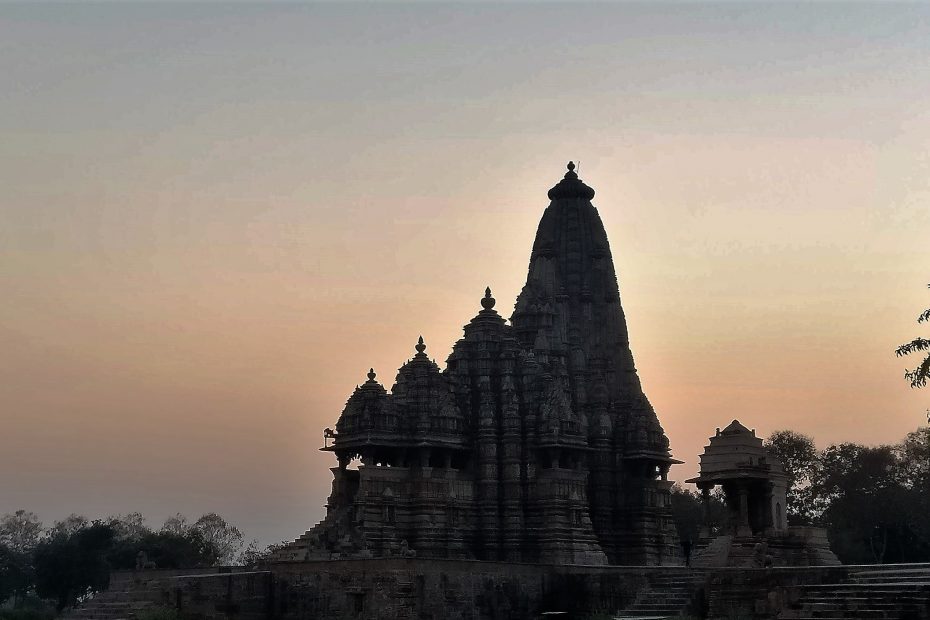
The Khajuraho temples were built between AD 950 and AD 1150 by rulers of Chandela Dynasty. Out of the 85 or so temples originally built, 20 have survived the test of time. The temples are segregated into Western Group (the most visited) , Southern Group and Eastern Group of temples.

Each temple has its own entrance, a hall, a vestibule and a garbha-griha (sanctum). Sandstone with varying shades of buff, pink and pale yellow/cream are used. The temple rooms are such that they are placed on an East/West line and constructed with spiral superstructures adhering to a North Indian shikhara temple style. The marvelous architecture of the spire enchants you to keep looking at them, believe me!

Notice the spires and multiple shikharas leading to the zenith
The Curiosity
An inquisitive mind may not find peace after looking at the inscriptions, the sculptures engraved on the temple walls or the connection between short stories depicted in them and the present life. Why would people engrave life stories on the temples? Most of the sculptures contain animals, floral designs, apsaras, kings, hunting scenes, domestic scenes, tantric yogis and erotic scenes.

Our guide was well-informed to tell us that during the time when the temples were being built, people needed to be educated about the way of life. “What better way to do it than in the form of visual media?”, he explained. Regarding the eroticism depicted, his view was that the population was dwindling during those times with young boys going into brahmacharya (celibacy). The Kings thought that the people need to be educated regarding them to revive and sustain the race.

Although a valid perspective, I had a different take on this. My mind reasoned from the depictions that before entering the garbh-griha of the temple, one must let go off all the worldly desires and connections pulling him/her back from establishing a connection with God i.e. their own soul, in this case. The King or the common man all enter after shedding their worldly belongings and achievements. Hence, the prayer hall was devoid of any eroticism.
One looks at these temples and the immediate question that comes to mind – As the temples were discovered after almost 9 centuries since they were built, what was the logic behind building temples in the middle of nowhere hidden from everywhere? Was it the capital of the Chandela dynasty which was abandoned by the then ruler? But then where are the Forts/Palaces for the royal family to reside? If not, did Khajuraho have significance as a holy place where people used to come on pilgrimage?

I did some digging online to find that Mahoba, 50km north from there, was certainly their capital from some time after 11th century. Though the evidence suggests that these temples were active long after this, indicating that Khajuraho was the religious capital of the kingdom. Well, Khajuraho sure did flutter some grey matter in my brain during the trip!

The guide was referring to the sculptures and pointing out that this is how the people were living during those times. I beg to differ, again. When religious sites are built today, inscriptions adorning the walls are sayings/scenes taken from our scriptures. So, was it that the builders of that time may actually be depicting scenes from the scriptures and the people depicted may be even before the era of the temples and not the people living during those times? This cannot be said with full authority that the figures depicted were that of the common folk of that time. It leaves us in a cloud of doubt.


With our thirst for history quenched for the time being, we made our way towards a famous local restaurant, Raja Cafe’ . Surprisingly, it was giving vibes of a cafe’ not in Khajuraho but somewhere in a posh locality of a metro city. We went inside and ordered enough food to feed us for the next few days. 😛 With the sun setting over the temples, we savored every bite of the food and discussed about our day.
Soon, loudspeakers started blaring music which was more like a jack-hammer drilling in your head at low speed rather than music (New Year’s Eve parties). We decided to retire for the night as the exhaustion was overpowering our senses.

01st Jan 2018 – The New Year
We woke up early to cover Southern and Eastern Group of temples and start for the return leg by 9 AM, But God had other plans. With zero visibility outside, the fog and mist were playing havoc with our plans. We braved the chilly winds creeping into our jackets and decided to cover only the important temples which included the Jain temples and the Dulhadeo temple. Meanwhile, at the back of my mind I was cursing myself for not giving enough time for our stay in Khajuraho.

By 9 AM we returned back to our resort and had our breakfast. We packed some aloo parathas to eat on the way since we decided not to take any lunch break on the way.
After many detours (no thanks to Google Maps) , we reached Agra at around 1700hrs. It was not possible to continue ahead due to intense fog. We hastily booked a place to bunk for the night and decided to call it a day. While enjoying a sumptuous dinner at one of the local restaurants’ (Pinch of Spice) we looked back thinking about mesmerizing places covered during the last few days. With immense respect growing by the minute for our ancestors, we vowed to visit more such places and pledged to protect such marvels, We soon retired for the night only to begin the 2 hr ride back from Agra to Delhi next morning.
The Khajuraho Hangover was here to stay. And we had no complains!
